Showing posts with label Diseconomiesofscale. Show all posts

Diseconomies of scale

Diseconomies of scale occurs when long run average costs start to rise with increased output.
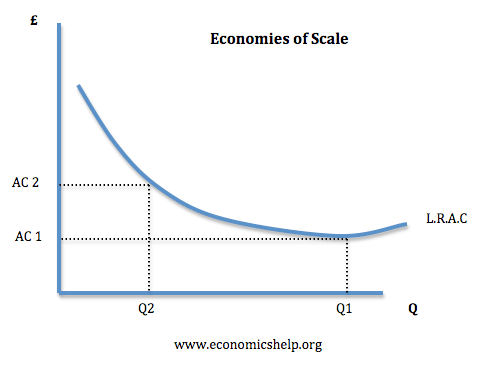
economies-of-scaleEconomies of scale occur up to Q1. After output Q1, long run average costs start to rise.
Dis-economies of scale can occur for the following reasons:
  1. Poor communication in a large firm
  2. Alienation: Working in a highly specialized assembly line can be very boring, if workers become de motivated. In a large firm there is an increased gap between top and bottom e.g. call centres
  3. Lack of control: when there is a large number of workers it is easier to escape with not working very hard because it is more difficult for managers to notice shirking.
Overcoming diseconomies of scale
Firms may attempt to overcome diseconomies of scale by splitting up the firm into more manageable sections. For example, a large multinational may be split up into local geographical areas, with local managers facing incentives to maximise efficiency.

Minimum Efficient Scale

This is the minimum point of output necessary to achieve the lowest A.C. on the LRAC. In the above diagram, the MEC is at Q1.
  • This has implications for the optimal number of firms in the industry
  • If the MES was 10,000 cars a week and the total industry demand was 40,000. This would mean that the optimal number of firm would be 4, if there were more firms in the industry then average costs would be significantly higher.
  • In a natural monopoly the optimal number of firms is one, therefore the MES would be equal to the total industry demand. E.g. Water or Electricity networks
The minimum efficient scale will be determined by factors such as:
  • i) Degree of fixed costs
  • ii) Scope for specialisation

Decreasing Returns to scale

Returns to scale relates to how a firms production is affected by increasing all the inputs.
Decreasing returns to scale implies that increasing the inputs by 50%, would increase the actual output by less than 50% (e.g. 40%)
Relationship with economies of scale
If a firm faces constant input costs, then decreasing returns to scale imply rising long run average costs and diesconomies of scale.
However, it is possible that if the firm gains purchasing economies then increasing the factor inputs by 50% may not actually increase costs by 50%. Therefore, it is possible to have decreasing returns to scale, but not necessarily diseconomies of scale. But, if we assume a constant input price, decreasing returns will cause diseconomies of scale.

Diseconomies of scale

A business can become so large that its unit costs begin to rise. Expanding firms can experience diseconomies of scale. Causes include:
A close-up of a skyscraper in Canary Wharf in London
  • Ineffective communication. Coordinating large numbers of staff becomes a challenge. Big businesses can develop many levels of hierarchy which slow down communication or even lead to miscommunication.
  • Reduced motivation. Staff can feel remote and unappreciated in a large organisation. When staff productivity begins to fall, unit costs begin to rise.

Diseconomies of scale

Diseconomies of scale occur when a business grows so large that the costs per unit increase. As output rises, it is not inevitable that unit costs will fall. Sometimes a business can get too big!

Diseconomies of scale occur for several reasons, but all as a result of the difficulties of managing a larger workforce.

Poor communication

As the business expands communicating between different departments and along the chain of command becomes more difficult. There are more layers in the hierarchy that can distort a message and wider spans of control for managers. This may result in workers having less clear instructions from management about what they are supposed to do when.
In addition, there may be more written forms of communication (e.g. newsletters, notice boards, e-mails) and less face-to-face meetings, which can result in less feedback and therefore less effective communication.

Lack of motivation

Workers can often feel more isolated and less appreciated in a larger business and so their loyalty and motivation may diminish. It is harder for managers to stay in day-to-day contact with workers and build up a good team environment and sense of belonging. This can lead to lower employee motivation with damaging consequences for output and quality. The main result of poor employee motivation is falling productivity levels and an increase in average labour costs per unit.
What can a business do about this? Possible solutions include:
Delegation of decision-making (empowerment)
Making jobs more interesting (job enrichment)
Splitting employees into teams (teamworking)
There is also a close link between communication and motivation (which the motivational theorist Elton Mayo recognized) and so as communication becomes harder, motivation will decline. This is particularly true as managers are less able to take a personal interest in the workers.

Loss of direction and co-ordination

It is harder to ensure that all workers are working for the same overall goal as the business grows. It is more difficult for managers to supervise their subordinates and check that everyone is working together effectively, as the spans of control have widened. A manager may be forced to delegate more tasks, which while often motivating for his subordinates, leaves the manager less in control.

Diseconomies of scale


Diseconomies of scale

DEFINITION of 'External Diseconomies Of Scale'

External factors beyond the control of a company increases its total costs, as output in the rest of the industry increases. The increase in costs can be associated with market prices increasing for some or all of the factors of production.

BREAKING DOWN 'External Diseconomies Of Scale'

Factors of production are the inputs that firms use in order to produce output. The inputs include land, labor and capital. Some economists include entrepreneurship as well.

For example, assume there is a manufacturer of 'widgets' in a given city. If the average wage level increases across all other markets as a result to an increased demand for labor, then to entice workers to produce "widgets", the manufacturer must pay more in wages, which will raise the total costs.


Read more

Diseconomies of scale

Diseconomies of scale is the point where a business no longer experiences decreasing costs per unit of output. Rather, after this point, costs per unit tend to increase.
Graphically, if output is on the X-axis, and average cost per unit is on the Y-axis, the economy of scale line curves downward from left to right. But as the line continues curving to the right, it reaches a point where it flattens and then begins to curve upward. The point where it starts curving upward represents the diseconomies of scale. 
A number of factors contribute to diseconomies of scale. 
For instance, if the manufacturing process involves multiple steps, there may be a volume level that creates a bottleneck for one process.  If, in the factory, process A is unlimited, but process B can only manage 50,000 units, then the company will experience diseconomies of scale above 50,000 units due to the added cost of acquiring more capacity for process B.
Shipping can also create diseconomies of scale.  For instance, a candle manufacturer sells candles to local merchants only. But if that candle manufacturer develops a website to increase production, then sells candles throughout the world, the added costs of shipping the candles may negate any cost savings resulting from increased output.
Finally, as a company grows, it has more communication and bureaucracy issues that interfere with efficiency.  If everything runs well, the concept of economies of scale works, but more output requires more people to run the company. 

Read more

Approach to teaching

Methods there are many, principles but few, methods often change, principles never do