The purpose of examinations in school is to test existing knowledge. Behind this simple objective lie many other objectives. Because exams exist and have to be passed, students are motivated to work harder than if there were no exams. There is an objective end-point. Exams provide a simple assessment of knowledge. They may not really test ability because some able students are just not good at exams.
Suppose there were a simple ‘test’ for organisations that would determine how those organisations rated on the ‘idea scale’. Organisations could apply that test to themselves. Investors could apply that test to the organisation. The stock market evaluation of an organisation could be influenced by the rating on that test.
How would such a test be administered? Would there need to be an investigating team that would go to the organisation and examine it thoroughly, using some framework for evaluation?
More simply, it could be done the other way around. A special body could say to an organisation: ‘Prove to us that you do have powerful new ideas. It is up to you to convince us’. A rating would then be given on this basis.
It may be thought that ideas are risky. It may be thought that investors would avoid companies with too many ideas. Research in the US shows the contrary. Organisations that are known to have ideas get marked up - not down. Of course, there are many difficulties in assessing ideas. There are small incremental ideas where the risk is low, but over time the ideas add up to a big change. There are high risk and high reward ideas.
Do you measure the new ideas that are being used? Do you measure the new ideas that are in development? Do you measure new ideas at the ‘concept’ stage before they have been developed or even evaluated?
What is to be measured? Is it the number of ideas or the value of the ideas? Is it the number of actual ideas or the ability to have ideas? It might even be the willingness to act on new ideas and to invest in them. There are organisations that are good at having ideas, but very reluctant actually to use any of these.
How many organisations believe that they have sufficient ideas? In my experience several organisations believe that they have too many ideas, but this usually means two things. The first is a lot of not very good ideas. The second is a reluctance to develop or use ideas.
How many organisations realise that they need ‘additional ideas’? This does not mean that they are short of ideas. It means that the existing ideas have arisen within the context, idiom and history of that organisation. As a result they are of a certain type. There may be a need for additional ideas from outside. That is why I have set up an ‘Outsourcing Creativity’ system to provide organisations with additional ideas that have not arisen from within their own cultures.
Executives are promoted on the basis of ‘continuity’. This means that they continue to run things as they should run. It means effectiveness and efficiency and an ability to solve problems as they arise.
Executives are blamed for mistakes that they make. Executives are blamed for failures when a new venture does not succeed. Executives are never blamed for the ideas they do not have. They are never blamed for the opportunities they do not see.
Having new ideas is a risk. Not having new ideas is no risk at all. It is not difficult to see which way behaviour will go. All this could be changed if there was an ‘expectation’ that executives should be having new ideas. If there were to be a sort of new idea ‘quota’, then every executive would be expected to show how he or she met that quota.
DEALING WITH NEW IDEAS
There is a long way between having a new idea and putting it into action. The first step is to note that there is a new idea. The new idea is recorded. The person who had this new idea gets some recognition on this account. When General Electric asked its creative people what they most wanted from their creativity, the surprising answer was ‘recognition’. This means that someone has noted that you have contributed a new idea.
The next step is to develop the idea and take it further so that it becomes a fully-fledged idea. Examination and evaluation of benefits and possible benefits then follows. The next step is feasibility. Can it be done? Can it be done within our existing mechanisms, or is there a need for new mechanisms?
Why should benefits come before feasibility? Because if perceived benefits are large, then much more effort will be made to find a feasible way of implementing the idea.
Then there are the negatives. These include costs, barriers, acceptance, etc., etc. The idea can be modified to overcome some of the negative considerations.
Finally the idea finds its place among the strategic priorities. In some cases there may be a need for a pilot study or further research. If this effort shows even stronger values than had been supposed, then the idea becomes more attractive and moves to the forefront of strategic priorities. What is important is that new ideas are not treated as some exceptional aberration. There needs to be a production process in place to produce and deal with new ideas as a routine matter.
THE HIDDEN VALUE OF NEW IDEAS
If a new idea is not chosen for action, we assume that the idea is lost and rejected. This should not be the case. An idea that is not used right now can enter a reserve file. Under different circumstances that idea can be brought forward again and used. In a different competitive climate the idea may have a higher value.
Even if the idea is never used, the thinking that has gone into developing that idea is not wasted. In the thinking involved there may be new concepts and new values which come to exist in their own right. Such new concepts and values can influence all further thinking on that subject, even when the idea itself is not used.
Creative thinking is never a waste of time. The activities of the mind during creative thinking enrich the mind in its experience of that subject. New possibilities are brought forward. New perceptions are visited.
SELF-IMAGE
Most organisations like to think of themselves as creative. Their advertising agencies tell them to advertise the organisation as creative. Creativity is seen as comparative. Are we as creative as this other organisation? On that basis, if no organisation is really creative, then all organisations are free to consider themselves creative.
If there were to be a simple test for the creativity of organisations, this would be of help to both investors and those working within the organisation. I shall see what can be done about developing such a test. (Source: Edward de Bono)
Showing posts with label Lateral Thinking. Show all posts
Showing posts with label Lateral Thinking. Show all posts

Time for THINKING students to enrol in yet another course!
This is FREE and is yet another course:
a. to put on UCAS
b. to improve your thinking
c. to improve your educational development
a. to put on UCAS
b. to improve your thinking
c. to improve your educational development
ENROL YOURSELF IN THE FIRST TEN LESSONS

This is the school that you don’t have to go to.
We can come to you!

Anyone. Anywhere. Anytime.
Web-based training: If you want training on How To Think Beyond Critical Thinking register your name and email address on this site and you will start to receive The First Ten Lessons.
You will immediately get an email asking you to click and confirm your enrollment and then you’ll get your First lesson. Why don’t you give it a go?

There are several levels of training for SOT members. They are sequential–each level follows on from the previous level.
If you finish The First Ten Lessons you are able to continue on with BCT, the next more advanced level of training, and you will receive an additional 27 lessons. BCT stands for Beyond Critical Thinking.
If you complete all 37 lessons you will receive the BCTcertificate1.pdf.
Greyscale Thinking
IS IT TRUE?: Greyscale Thinking
In our exploding world of cybermedia with peer2peer messaging at the speed of light, the global epidemic spread of lies may be one of the most serious challenges facing long-term human survival.
I believe this challenge needs to be taken very seriously and could be considered to be of a threat level similar to that of Avian or Bird Flu. Many scientists share this view.
As an antidote, I am now putting forward a new thinking methodology to help meet this challenge. To follow on from the previous SOT thinking tools, thinking hats and brain software, this new tool is called: greyscale thinking: how to sort a truth from a lie.

What Makes A Great Teacher?
Clearly there are several characteristics:
a. the willingness to work outside of school hours
b. posting on blogs to help pupils - even though he is on holiday over half term
c. the constant encouragemnent and coercion - urging students to achieve greater things - to fulfil potential
d. the ability to make decisions - to cast aside the deadwood and remove them from the Economics group so the group as a whole can truly go ahead and conquer (adn the deadwood also gains)
e. to 'negotiate' with 'management' as to what the students do next. To do so putting himself at risk - purely for the betterment of the pupils
f. the willingness to self-deprecate, to accept that all of us have something to learn
g. a passion for the subject and the process by which the subject is deliveredWhile there are many things that can make a teacher a much better one there is one non-negotiable, one litmus test, which defines a great teacher. This test is about how the teacher’s performance stacks up to the BIG question: IS IT TRUE?
Is It True?
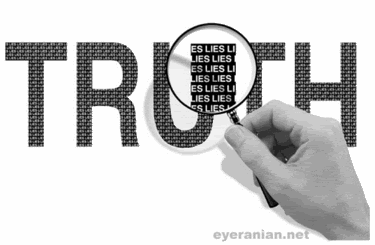
Is what the teacher is teaching a TRUTH or a LIE? The answer to this question is what sorts out the frauds from the professors. If this test is passed then the teacher can be a great teacher if not then the teacher will always be a failure … in my view.
Making Claims
Anyone can make a claim. All sorts of claims are made in business, in science, in religion, in families, in governments, in education, in politics, in the media. But is it a true claim? Or, is the claim a lie? How do we know? Does it even matter?
Yes. It does matter whether a claim is a truth or a lie. For example, many people believe things which are dangerous lies. These lies may have been protected from thinking for hundreds of years. These lies all have consequences which may range from deception to dementia to death.
Like a brainvirus, these lies can infect the brains of very young children. This is happening right now to millions of children as you read this article. I do believe that the global epidemic spread of lies may one of the most serious challenges facing long-term human survival.
ANTIDOTE: If you feel this is important (please don’t spam lists of people) but send this article on to selected friends, colleagues and family who may find it useful.
Greyscale Thinking
To help meet this challenge I am introducing the idea of greyscale thinking (US grayscale). Greyscale thinking is simple, fast and scientific. Anyone, anywhere and anytime can use greyscale thinking to help sort out a truth from a lie.
Any child can learn to use it. Greyscale thinking can be taught to kids by parents and by teachers. Any employee can learn to use it. Greyscale thinking can be taught to employees by managers and business leaders.
The idea of greyscale thinking is: claim divided by questions equals truth or lie. This idea can be expressed as the formula c÷q=t>l.
This means that once a ‘claim’ is made it can then be subjected to ‘questioning’. Questioning reveals whether the claim is closer to being either a ‘truth’ or a ‘lie’.
Six True Questions
SIX TRUE QUESTIONS: The methodology of greyscale thinking is the cognitive skill or habit of putting a CLAIM to the SIX TRUE QUESTIONS: What and Where and When and Why and How and Who - (Click here for more on the questions).
The answers to each of the 6 questions moves the CLAIM to and fro along the greyscale continuum: | a TRUTH - w? w? w? w? h? w? - a LIE |
______________________________________________________________________________________________

| a TRUTH • • • • a LIE |
______________________________________________________________________________________________
The answers to each of the 6 questions indicate, on the balance of the evidence, whether the CLAIM is more likely to be a TRUTH or more likely to be a LIE.
MAIN POINT: You will have noticed we are saying “a truth” rather than “The Truth”. Searching for truth is a journey and not a destination. We are more concerned with being right than being righteous. No individual brain can ever contain perfect knowledge of all possible facts. No brain can ever know the contents of the other people’s brains who are also involved in the situation. No brain can ever be have ownership of The Truth. And, that’s the point.
The rule of science is that you can have a good idea today, a better idea tomorrow, and the best idea … never! Why? Because there are always more facts to uncover–more opinions, more priorities, more options, more consequences, more positives, more negatives, more objectives, more measurements, and more experiments that can be tested. History has shown this to be a truth.
It is the deliberate effort one makes to move closer to a truth and to move further away from a lie that produces all the benefits of greyscale thinking.
No claim should ever be protected from questioning
Any claim that has ever been made in all of history and any claim that ever will be made can be illuminated, examined, investigated and accepted or rejected using the 6 true questions of greyscale thinking: What and Where and When and Why and How and Who - (Click here for more on the questions).
59 second course in THINKING
59 Second Course in Thinking: e + s = t
In any situation, thinking involves two basic processes:
escaping from your current view of the situation, and
searching for a much better view of the situation.
•
ESCAPE + SEARCH = THINK
The Current View of the Situation (cvs)
can never be equal to
the Better View of the Situation (bvs)
(cvs≠bvs)
Escape from your cvs
and search for a bvs!
(cvs2bvs)
You can search for a bvs that is
ten times better than your cvs.
(cvs X10 = bvs)
•
ESCAPE
If we can escape from our current viewpoints, thinking patterns, righteousness and established ways of doing things–our CVS–we can then take a quantum leap ahead of our own experience and jump to ‘a much better way’–a BVS. We can experiment and we can innovate.

SEARCH
Search for alternatives, options and possibilities because there is ALWAYS a BVS!
There are always many, many different ways of looking at any particular situation. Whatever it is that we are currently doing, someone else, somewhere, is already doing it a “much better way”. Once we escape from the CVS–the current way–we can search for the BVS–the much better way.

We can always change our perceptions–the way we look at things.
For more insights on this see also:
and
THINK
Thinking is a skill. To become proficient in escaping from your CVS and searching for a BVS (the much better way) always involves practice and repetition–at least ten times–if we are to build new cognitive patterns and acquire skill and virtuosity.

Watch a short film
This is a short documentary film written and directed by Ray Eames and her husband, Charles Eames in 1977. This classic film depicts the relative scale of the Universe (as far as was known 20 years ago) in factors of ten and is called Powers of Ten
Now watch the parody:
Now watch the parody:
Subscribe to:
Posts (Atom)